


Last updated on July 15, 2026
They’ve never had more ways to talk, share, and stay in touch. Messages are instant. Friendships live in group chats. Social lives unfold through screens, stories, and endless scrolling. On the surface, connection has never been easier. And yet, Gen Z loneliness is becoming one of the defining issues of this generation.
Because being constantly connected doesn’t necessarily mean feeling seen, understood, or close to anyone. In fact, for many, it’s doing the exact opposite.
So what changed?
How did a generation raised on connection end up feeling so alone? Is it really just social media to blame, or is something deeper going on?
Keep reading, vote in polls and share your thoughts.
Gen Z loneliness and the pandemic effect
The shift didn’t start with the pandemic, but that’s when everything accelerated. Almost overnight, daily life moved online, and while that kept the world running, it also quietly reshaped how we connect.
Here’s what that shift actually looked like in numbers:
- Remote work exploded: before 2020, only about 5–7% of employees in the EU worked primarily from home. During lockdowns, that number jumped to 40%+ in some countries.
- Zoom went from ~10 million to 300 million daily meeting participants in just a few months.
- Microsoft Teams grew from 32 million daily users (2019) to over 270 million.
- WhatsApp and Messenger video calls more than doubled, with some reports showing a 50–70% increase in usage during peak lockdown periods.
Even for those not in the workforce, like much of Gen Z, the effect was similar. School, friendships, entertainment… everything shifted to screens.

And once that shift happened, it didn’t fully go back.
Social media usage surged even further:
- More time spent scrolling
- More passive consumption
- More “connection”, but less real interaction
This is where Gen Z loneliness becomes more than just a trend. Because when your entire world moves online — and stays there — the line between being connected and feeling alone starts to blur.
And with growing uncertainty in the world today, some are already asking whether we could be heading toward another lockdown — and what that would mean for a generation that never fully reconnected in the first place.
More online, less connected
If the pandemic accelerated the shift, Gen Z fully adapted to it. For them, being online isn’t a phase, it’s the default.
Today, their communication looks very different from previous generations:
- Texting over calling: around 95% of Gen Z prefers messaging over phone calls
- Short-form content dominates: platforms like TikTok average 60–90 minutes daily usage among Gen Z users
- Multiple platforms at once: it’s common to switch between Instagram, Snapchat, TikTok, and WhatsApp within minutes
- Voice notes & DMs replace conversations: quick, low-effort interactions instead of deeper exchanges

And the numbers back it up:
- Average daily screen time for Gen Z is now estimated at 7–9 hours per day
- Social media usage increased by ~30–50% during and after the pandemic period
- Over 70% of Gen Z say they feel more comfortable expressing themselves online than in person
But here’s the catch. More communication doesn’t automatically mean better connection.
A message is not a conversation. A like is not validation. And constant interaction can still feel… empty.
We’ve already explored how this plays into anxiety in more depth in our article on social media and anxiety. Because the same platforms that connect people are often the ones increasing pressure, comparison, and emotional fatigue.
This is where Gen Z loneliness deepens. Not because they lack communication, but because much of it happens on the surface — fast, fragmented, and easy to exit.
We want to hear your thoughts.
Did the pandemic make everything worse?
Will we ever go back to “normal”?
And why do Gen Z feel so lonely?
Vote in polls or leave a comment.
Always connected, never at ease
Gen Z didn’t just grow up online, they grew up in a world that never switches off.
Notifications, messages, updates, new content… it’s constant. There’s always something happening, always something to check, always someone to respond to. One of the problems here is also that the social media algorithms are designed to keep us online. And even in moments of rest, the mind doesn’t fully slow down — it just scrolls.
This kind of always-on environment comes with a cost.
- Constant notifications → no real mental downtime
- Social media → endless comparison and pressure
- Being “available” 24/7 → low-level anxiety that never fully disappears
But there’s another layer we don’t talk about enough:
Overstimulation
Screens are designed to capture attention. Bright colors, fast cuts, instant rewards, endless novelty. Every swipe brings something new. Every app is competing to keep you there just a little longer.

And then you step away from it. You go outside. Into nature. Into silence.
If you have kids that are Gen Z-ers… do you relate? They are bored. They don’t know what to do with themselves. There are no flashing lights and no constant dopamine hits. Just stillness.
Have you read the article about the dopamine effect? For a brain that’s wired on constant stimulation, real life can start to feel slow, even boring. And that’s a big problem. Because real connection, real presence, and real relationships all live in that slower space.
See other polls about PSYCHOLOGY
This is where Gen Z loneliness takes on a different dimension. It’s not just about being alone, it’s about losing the ability to feel engaged and connected without constant stimulation.
So no, it’s not just the pandemic.
It’s the system.
The design.
The screens.
And we’re only starting to see the effects.
Why Gen Z loneliness feels worse than any generation before
It’s easy to assume that every generation struggles with loneliness in the same way.
But the data suggests otherwise.
Recent studies show that Gen Z reports the highest levels of loneliness compared to any other generation. In one global survey, nearly 8 out of 10 Gen Z individuals said they experienced loneliness in the past year, significantly more than millennials, Gen X, or baby boomers.
And it’s not just about loneliness — it’s about overall well-being.
For decades, happiness followed a predictable pattern: you were happiest when you were young, it dipped in midlife, and then rose again later. But newer research shows that this pattern is starting to break.
Freedom of speech is becoming the most controversial right
Instead of starting high, young people today are reporting lower levels of well-being much earlier in life, with factors like social media use, reduced in-person interaction, and constant comparison playing a major role.
At the same time:
- 1 in 3 Gen Z say they don’t get enough real human interaction
- Many report going days without meaningful conversation
- Nearly half feel lonelier than they did just a few years ago
So what’s different?
Previous generations had fewer ways to connect but the connections they had were often deeper, slower, and more consistent.
Gen Z has the opposite. More ways to communicate and more visibility into other people’s lives. But the connection is only on the surface. There is no depth.
This is what makes Gen Z loneliness feel heavier. It’s not just the absence of connection, it’s the constant exposure to it. Seeing everyone else socializing, thriving, living… while yourself feels disconnected.
And over time, that gap becomes hard to ignore.
When loneliness becomes the norm
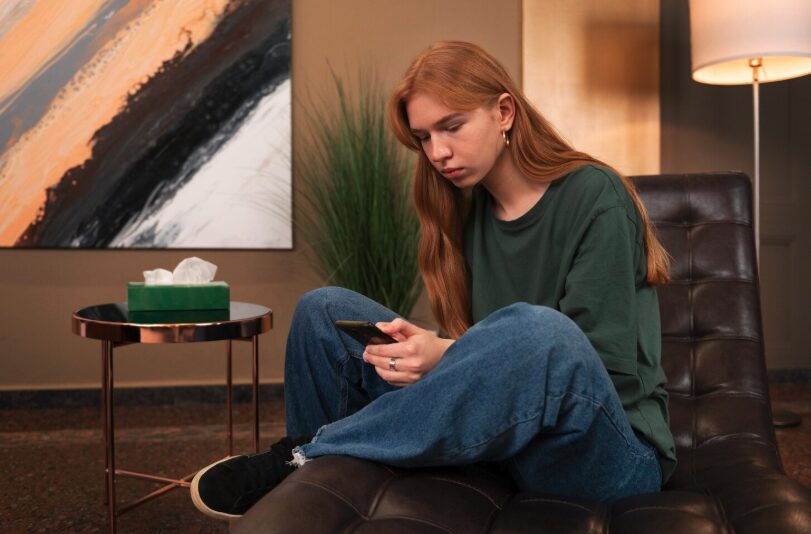
At first, it doesn’t feel alarming. Canceling plans. Staying in. Choosing your phone over people.
It feels comfortable. Easier. Safer. Until it stops feeling like a choice.
Because the more time you spend alone, the more normal it becomes.
This isn’t just a feeling, it’s showing up in the data.
- Rates of anxiety and depression among young people have increased by over 25% globally in recent years
- In some countries, more than 1 in 5 young people report struggling with their mental health
- Suicide is now one of the leading causes of death among people aged 15–29 worldwide
At the same time, social behaviors are shifting:
- Fewer in-person interactions
- Fewer close friendships
- Less time spent outside the home
And more time online than ever before.
If isolation becomes your routine, connection starts to feel like effort.
Awkward. Draining. Even unnecessary.
So you scroll instead. You watch instead. And you stay in your space where everything is controlled, predictable, and safe.
There’s a word for what happens when disconnection goes to the extreme.
It started in Japan, but it’s no longer just a cultural phenomenon.
People, mostly young, retreat into their rooms for months, sometimes even years. They isolate themselves from friends and all real-world interactions. They don’t go to school or work. But they do spend most of their time online. In a meta universe, behind closed doors. Their friend is their screen. They find their comfort in the digital world, while the real one feels overwhelming.
Are we seeing the same development with the Gen Z generation? Vote!
Because this isn’t just an extreme case. It’s a direction. And the question is no longer if it’s happening…but how far it can go.
What do you think?
Is Gen Z actually more lonely or just more open about it?
Are screens connecting us… or quietly pulling us apart?
Vote in polls.
Share your experience in the comments.
This is SpeakOutZone.
Your voice. Your platform.

I’m not a doctor or a scientist. I’m a marketing professional who spent years working with health and lifestyle brands. I read a lot, ask a lot, and write about the topics that are worth debating about. My goal isn’t to tell you what to think. It’s to give you well-researched perspectives, honest opinions, and space to voice your thoughts.