

Last updated on June 16, 2026
Gaming has become a normal part of everyday life, especially for younger generations. What once felt like an occasional hobby has quietly turned into something much bigger. Online games are always within reach: on phones, consoles, and computers, available at any moment of the day.
And on some days, we find ourselves playing games for hours. The real world fades into the background. Time disappears. Day turns into night. And still, it feels hard to stop. What is happening?
It’s not just about fun anymore. The more we play, the more our brains start to crave the reward. It’s that feeling of “just one more win” that makes it so hard to put the controller down. A constant pull that keeps bringing us back.
And that raises an important question:
Is gaming simply entertaining… or is it designed to keep us playing? Do you think your kids spend too much time playing online games? Vote.
The rise of gaming and screen time among teens
To understand why gaming feels so hard to stop, we first need to look at how much time children and teenagers are actually spending on screens today.
Over the past decade, screen time among teens has increased dramatically, with recent studies showing that the average teenager now spends around 7 hours and 20 minutes per day on screens, not including school-related use.
A significant part of that time is no longer just social media or passive scrolling. Gaming has become one of the dominant digital activities, especially among younger users. Research shows that teenagers typically spend around 10 to 15 hours per week gaming, with sessions often lasting 2 to 4 hours at a time, especially on consoles and PC.
What stands out is not just the total amount of gaming, but the pattern: long, immersive sessions that often stretch far beyond what users initially planned.

Do social media algorithms shape our behavior?
This is where gaming starts to shift from a casual activity into something more complex. Something driven not just by choice, but by design, psychology, and reward systems.
So I can’t stop wondering if gaming is still something children simply “do”?
Because it feels like something that is hard to stop once it starts. What do you think? Are our children spending too much time online, on screens, in meta universes that are pulling them away from real life? Leave your comment below.
Why gaming feels so hard to stop
This shift is exactly what many people notice, even if they can’t fully explain it.
Gaming is no longer just about playing a game and logging off when you’re done. Modern games are built around progression loops. Small rewards, constant achievements, and a sense of “always something next.” There is rarely a true stopping point, because the experience is designed to continue.
The more you play, the more the system responds to you. You level up, unlock rewards, complete challenges, and get immediate feedback. This creates a cycle where gaming continuously reinforces itself, making it harder to step away than to stay inside it.
It’s not necessarily about lack of self-control. It’s about how frictionless the experience has become. There are no natural pauses anymore. No clear endings, no real breaks in momentum. Just an endless flow of “one more match,” “one more quest,” “one more win.”
From analog games to digital systems, what changed?
There was a time when gaming meant something very different.
Board games, outdoor games, card games, they all had natural boundaries. You played with friends in the same room, you set up the game, you finished it, and at some point, someone said: that’s it for today. There was a clear beginning and a clear end.
Even losing didn’t pull you back in immediately. You’d pack the game away, move on, and come back another day.
But modern gaming works differently.
Today’s digital games rarely have a true stopping point. There is always another level, another reward, another match waiting instantly. And we see the same design logic also elsewhere. Do you see the connection?
Social media feeds never really end. Short-form videos autoplay. Notifications are timed to pull you back in. Every platform is built around the same principle: keep you engaged for as long as possible, without a natural moment to stop.
What connects all of this is not just entertainment — but how our brain responds to reward. The constant loop of anticipation, action, and reward is what keeps us scrolling, clicking, and playing longer than we intended. It’s the same mechanism that appears across gaming and social platforms alike. Our brain craves for the dopamine hit with every like, win, message and parents are getting concerned. Are we pushing kids into an addiction and are not even aware of it?
We explored this in the article: Social media dopamine effect – welcome to the addiction economy. Go read it, vote, comment, we’d love to hear your thoughts.
Does gaming influence how we react?
Most of the time, we talk about gaming in terms of time: how long we play, how hard it is to stop, how easily we lose track of it.
But there’s another layer that often stays in the background.
Not just how long we play but how these experiences might shape the way we react.
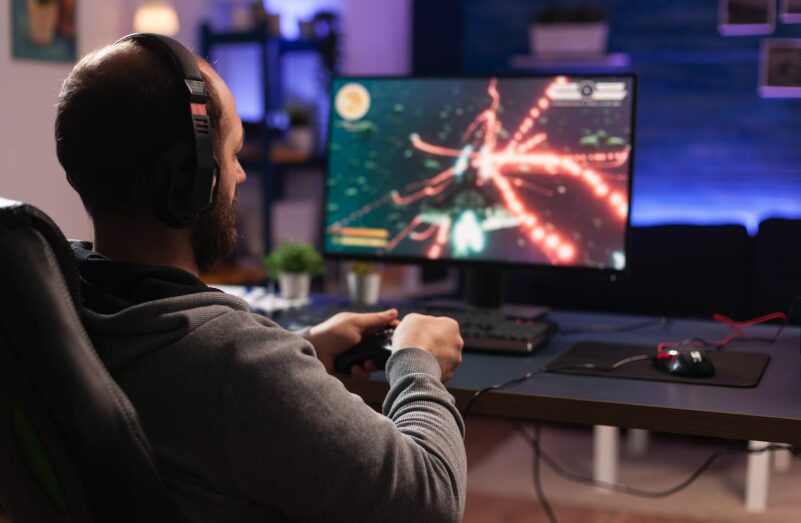
Fast-paced games, especially those built around competition, pressure, and constant action, can create intense emotional responses. Frustration after losing. Adrenaline during gameplay. The urge to win, to respond quickly, to stay alert at all times.
Some research suggests that repeated exposure to highly stimulating or even violent game environments can temporarily increase aggressive thoughts or reduce sensitivity to certain content.
See other polls about CULTURE
This doesn’t mean gaming directly leads to real-world violence. But it does raise a quieter, more uncomfortable question:
If these systems can influence how long we stay and how often we return… could they also be shaping how we respond, feel, and process situations… even after we log off?
Are we still in control?
Gaming has changed. So has the way we interact with digital worlds. What used to be simple entertainment has become something far more immersive, continuous, and difficult to step away from.
And gaming is not alone in this. Social media, streaming platforms, and almost every corner of the internet now operates on the same principle: keeping us engaged for as long as possible.
Whether we realize it or not, we are living inside systems designed around attention. Systems that learn from our behavior, adapt to it, and refine the way they keep us coming back.
The question is no longer whether this affects us.
The question is how much it already has.
Because over time, constant stimulation reshapes more than just our habits.
- Attention spans feel shorter.
- Focus becomes harder to sustain.
- Moments of boredom feel almost uncomfortable.
Maybe we are not just users of these systems. Maybe we are part of how they evolve.
So maybe it’s time to pause and ask:
Is this still something we control… or something that quietly shapes how we think, focus, and experience the world?
- How has gaming changed for you?
- Have you noticed a shift in your attention or habits?
- And where do you think the line is between entertainment and overuse?
Voice your thoughts. Leave them in the comments.
This is your SpeakOutZone.
Your voice. Your platform.

I’m not a doctor or a scientist. I’m a marketing professional who spent years working with health and lifestyle brands. I read a lot, ask a lot, and write about the topics that are worth debating about. My goal isn’t to tell you what to think. It’s to give you well-researched perspectives, honest opinions, and space to voice your thoughts.