


Last updated on June 25, 2026
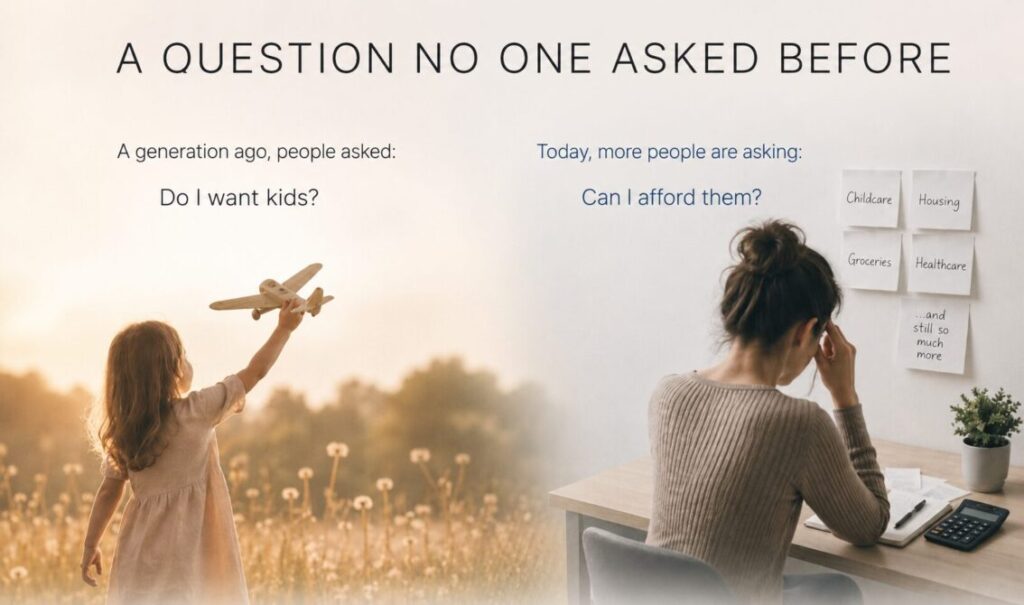
Having children is seen as a natural step in life. Right?
Even in the past, when we didn’t have all the commodities of modern life, people had children. It wasn’t always easy, but it felt possible. Families adjusted, budgets stretched, and somehow, things worked out.
Today, that confidence is starting to disappear.
The cost of raising a child has increased dramatically over the past few decades and for many people, it’s no longer just a question of wanting children, but whether they can realistically afford them.
What used to be a personal decision is quickly becoming a financial calculation.
What is the cost of raising a child today?
Let’s look at the numbers.
Today, the average cost of raising a child per year ranges between:
- $15,000 – $20,000 in the US
- $10,000 – $15,000 across many European countries
These costs include basic necessities like food, clothing, education, transportation, and childcare but they don’t fully capture the hidden costs that come with modern parenting.
And then there’s housing. You can read more about the housing problem HERE.
It didn’t always look like this
Around 30 years ago, the picture was very different.
The average yearly cost of raising a child was significantly lower: roughly $5,000 to $7,000 per year. Even when adjusted for inflation, that would be around $10,000 to $12,000 today.
More importantly, incomes were more aligned with living costs.
A single income could support a family. Housing was more affordable. And while raising children still required sacrifices, it didn’t feel financially overwhelming in the same way it does now.
The real problem isn’t just the cost
It’s not just that raising children is expensive. It’s that costs have increased much faster than incomes.
Housing prices have surged. Daily expenses have climbed. Childcare has become one of the biggest financial burdens for young families.
At the same time, wages have not kept pace.
And that creates a growing gap between what families earn and what they need.
Housing changed everything
One of the biggest shifts is housing.
For many families, housing is now the single largest expense, often taking up a significant portion of income. And when a large part of your budget goes toward simply having a place to live, everything else becomes harder to manage.

Raising a child in that environment is not just about covering daily costs — it’s about whether there is any financial space left at all.
This is where the issue connects directly to the broader housing crisis.
When owning a home feels out of reach, and rent continues to rise, long-term planning becomes more uncertain. Starting a family becomes something people delay or reconsider entirely.
Why more people are choosing not to have kids
Across many countries, birth rates are declining. There are many reasons for this, but financial pressure is a major one.
People are:
- waiting longer before having children
- choosing to have fewer children
- or deciding not to have them at all
This isn’t necessarily because they don’t want a family. It’s because the cost of raising a child no longer fits into the reality of their financial situation.
Is having kids becoming a luxury?
This is where the conversation becomes uncomfortable.
Because when something essential becomes too expensive for a large part of the population, it starts to shift from a basic life choice into something else. Something less accessible.
See other polls about FAMILY
When:
- housing takes most of your income
- savings feel impossible
- financial stability is harder to achieve
Having children starts to feel like a privilege.
And that changes how people think about the future.
What’s really driving the cost of raising a child?
There are obvious explanations:
- inflation
- higher living standards
- increased expectations around parenting
But there are also deeper structural factors.
Housing has become more expensive. Education costs have increased. Childcare has turned into a major financial burden, especially for working families.
At the same time, income growth has been relatively slow.
Overall, we can say that society is changing and is affecting the birth rate. If fewer people can afford to have children, that affects:
- population growth
- economic stability
- long-term social structures
And it raises bigger questions about what kind of future is being built.
Some feel the pressure directly. Others are watching it happen around them.
What do you think?
Is the cost of raising a child becoming too high?
Have financial concerns ever made you rethink having kids?
Drop your thoughts in the comments. This is a conversation more people are starting to have.
This is your SpeakOutZone.
Your voice. Your platform.

I’m not a doctor or a scientist. I’m a marketing professional who spent years working with health and lifestyle brands. I read a lot, ask a lot, and write about the topics that are worth debating about. My goal isn’t to tell you what to think. It’s to give you well-researched perspectives, honest opinions, and space to voice your thoughts.