


Last updated on July 27, 2026
In the last decade, childhood has quietly transformed.
Not so long ago children spent afternoons climbing trees, riding bikes, or arguing over board games. Today, they spend hours scrolling, streaming, messaging, and gaming. Smartphones are no longer luxury devices — they are social passports, entertainment hubs, learning tools, and, increasingly, emotional regulators.
According to recent data, kids spend over 7 hours of screen time on weekdays and more than 8 on weekends. Alongside this shift, rates of childhood anxiety and depression have climbed to record highs. Researchers have spent years asking: is this correlation, or cause? The 2026 evidence is starting to give a clearer, and yes, also uncomfortable, answer.
The rise of phone-based childhood
The debate around screen time effects has intensified. Parents are worried. Schools are reacting and asking if smartphones should be banned in schools. Researchers are publishing data at a rapid pace. And social media is full of heated opinions.
But the real question remains:
Are phones making childhood more anxious?
Before jumping to conclusions, let’s unpack what we actually know — and where the debate becomes emotional rather than evidence-based.
Screen time effects on children: what the research actually shows
When people search for “impact of smartphones on children” or “smartphones and teen mental health”, they’re usually worried about anxiety, depression, and attention problems. But the link between screen time and mental health isn’t just parental worry. It’s been documented across dozens of peer-reviewed studies.
A 2026 meta-analysis of 23 studies found that children and adolescents with higher levels of screen time showed significantly increased rates of depression and anxiety. Smartphone usage in particular had the strongest correlation with depressive symptoms.
A landmark Lancet study published in late 2025 went further. Tracking children from infancy, researchers found that high screen time in infancy accelerated maturation of visual and cognitive control networks in the brain — and that this accelerated development was linked to higher anxiety levels and slower decision-making in adolescence.
In simpler terms: too much screen exposure in early childhood may actually change how the developing brain matures. The problem is, that consequences can be seen years later:
- increased anxiety symptoms
- sleep disruption
- reduced face-to-face interaction
- shorter attention spans
But correlation is not the same as causation.
Children who are already anxious may turn to phones for comfort. Socially isolated teens may use digital platforms to connect. The relationship between screen time effects and mental health is complex.
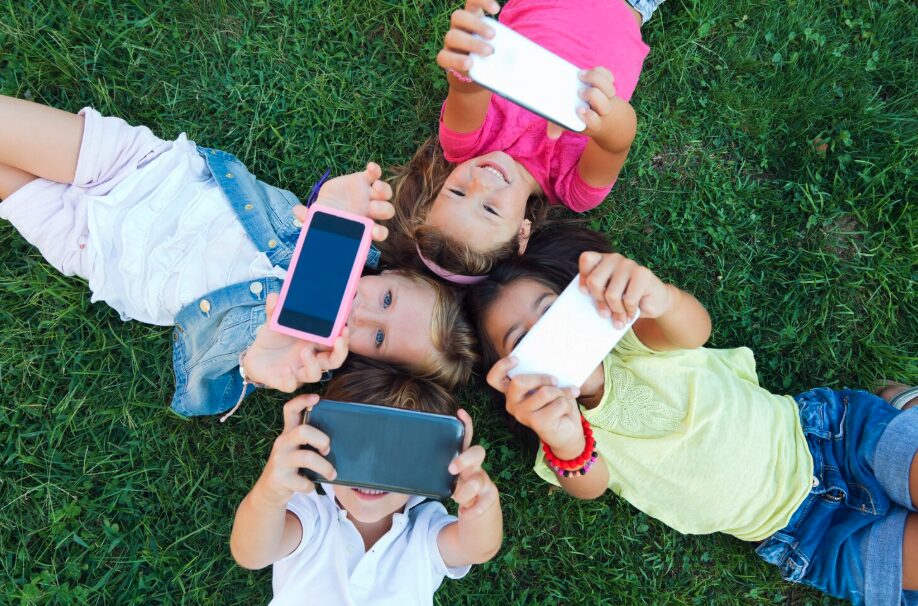
Still, one thing is clear: childhood today is more digitally saturated than ever before which turned the developmental patterns upside down.
Smartphones and emotional development
One growing concern is emotional resilience.
Children were bored even before smartphones. But then, they had to find innovative ways to stave off boredom. Which was actually an excellent way to keep their brain active and develop a healthy emotional connection.
Today, when children feel bored, uncomfortable, or socially awkward, smartphones offer instant distraction. The discomfort disappears in seconds. But so does the opportunity to learn how to tolerate frustration.
Some psychologists argue that this “instant relief culture” may weaken coping mechanisms.
Instead of sitting with boredom, negotiating playground conflicts, and navigating social rejection in person, many children escape into curated digital spaces.
Does this increase anxiety long-term?
The anxious generation: a controversial argument
A major voice in this debate is social psychologist Jonathan Haidt in his book The Anxious Generation. The book argues that the shift from play-based childhood to phone-based childhood has contributed significantly to rising anxiety and depression among young people.
One powerful line from the book states:
“We have overprotected children in the real world and underprotected them in the virtual world.”
Haidt suggests that the decline of independent play combined with unrestricted smartphone access has reshaped adolescence in ways we are only beginning to understand.
His argument resonates strongly with many parents. Others believe it oversimplifies a multi-factor problem that includes academic pressure, economic instability, and social change.
👇 Speak out zone – quick vote
Screen time and sleep disruption
A 2026 study published in Nature found that short sleep duration and irregular bedtimes acted as significant mediators between screen time and children’s anxiety and depression.
When a kid with a developing brain changes his sleep time with screen time, their mental health gets affected because of the sleep disruption. In other words, screens don’t just steal hours — they degrade sleep quality, and poor sleep is a well-established driver of anxiety and mood disorders in children.
Blue light exposure suppresses melatonin. Late-night scrolling delays sleep onset. Notification-driven wake-ups fragment sleep. All of it compounds.
Screen time and childhood anxiety: what parents are noticing
Let’s put the medical researches aside for a moment and see what parents are noticing about screen time and childhood anxiety.
Parents often report:
- mood swings linked to social media interactions
- sleep problems due to late-night scrolling
- irritability when phones are removed
- fear of missing out (FOMO)
Searches like “smartphone use and kids anxiety” and “effects of phone use on kids” continue to rise.

But here’s where the debate gets complicated.
Phones also:
- allow connection with distant friends
- provide access to educational content
- help introverted children communicate more comfortably
- offer creative tools (video editing, music, coding, art apps)

So are smartphones the villain — or are they simply powerful tools used without clear boundaries?
Screen time effects vs. content effects
Not all screen time is equal. Multiple studies suggest that adverse mental health effects rise sharply above a certain daily threshold.
A study of adolescents found that those spending more than 4 hours per day on screens had significantly higher symptoms of anxiety, depression, and stress compared to peers with lower use. Below that threshold, the link was much weaker.
Scrolling endlessly through appearance-focused social media is not the same as collaborating on a creative project, watching a documentary, coding a game or video-calling grandparents. Reasonable screen use probably isn’t the danger and content quality and context matter more than raw hours.
The pattern researchers keep flagging is passive, prolonged, high-frequency scrolling — the kind that dominates unstructured hours in a child’s day.
Should children have smartphones before age 14?
Let’s make this concrete. Cast your vote:
There is no universally agreed answer. Different cultures set different norms. Some communities delay smartphone access intentionally. Others consider it essential for safety and social belonging.
Attention spans, dopamine, and developing brains
Another major concern in discussions about how smartphones affect children’s brain development is attention fragmentation.
Apps are designed for engagement. Notifications, infinite scroll, short-form videos — all engineered to capture and hold attention. Engineered to keep hitting us with dopamine, little by little, so we always come back for more. Apps give us small instant pleasures that are hard to resist even for a grown-up, let alone for an adolescent or a child.
For developing brains, constant switching between stimuli may impact sustained focus, deep reading ability, delayed gratification, tolerance for boredom and more.
The social comparison trap
Childhood used to have limits. You compared yourself to classmates and neighborhood friends. Today, children compare themselves to influencers, celebrities, and filtered perfection. The constant exposure to curated lives may intensify insecurity and anxiety, particularly during adolescence.
Yet, others argue that online communities can also:
- validate niche interests
- support marginalized teens
- provide identity exploration
Again, the impact is not universally negative. It depends on the child. It depends on guidance and on boundaries.
The real question: phones or parenting?
Some critics say the smartphone debate distracts from a harder truth: adults struggle to model healthy digital habits themselves. While parents, teachers, and caregivers debate how much screen time is too much for children, they often overlook the fact that children are constantly observing adult behavior. Smartphones and digital devices are woven into the daily routines of grown-ups, subtly teaching lessons about priorities, attention, and presence.
Children observe:
- parents scrolling at dinner, often missing conversation or eye contact
- adults checking notifications constantly, even during family or social moments
- work bleeding into family time, with emails, calls, and messages demanding immediate attention
These behaviors normalize a constant state of distraction and reinforce the idea that being “always online” is acceptable or even expected.
Children are not only learning how to use devices; they are internalizing the patterns and priorities demonstrated by the adults around them. If smartphones are shaping childhood, they are also reshaping adulthood with blurred lines between work, leisure or social connections.
So perhaps the deeper issue isn’t simply screen time effects, but the pervasive digital culture as a whole, and how it subtly dictates attention, relationships, and even our sense of self.
What parents can actually do
I am not suggesting a return to a screen-free childhood, that ship has sailed. But I have kids also, and I find this few practical strategies to be really helpful:
- Protect sleep first. No screens in the bedroom, and a hard stop at least an hour before bedtime.
- Watch the total, not the type. A child using screens for schoolwork, gaming, and social media may hit 8+ hours without anyone noticing.
- Model it. Kids notice parents’ phone habits. Family screen rules that apply to adults too tend to stick.
- Prioritize offline connection. Face-to-face time with friends, outdoor play, and physical activity are protective factors that research consistently identifies.
- Talk about content, not just time. What a child watches or scrolls matters as much as how long — social comparison feeds are particularly harmful to teen mental health.
So… are phones making childhood more anxious?
There is no simple yes or no.
Smartphones amplify human tendencies, magnify social dynamics, and accelerate information flow.
For some children, they may increase anxiety.
For others, they provide connection and creativity.
What’s undeniable is this: Childhood has changed and we are still learning how to guide it.
Leave a comment:
👍 This topic needs more attention
👎 The debate is overblown
This is your SpeakOutZone.
Your voice. Your platform.
Frequently asked questions about screen time and children anxiety
Most research points to problems rising sharply above 4 hours a day of recreational use. The American Academy of Pediatrics recommends no screen time for children under 18 months (except video calls) and limited, high-quality content for older children.
No. Passive scrolling, social media, and short-form video (TikTok, Reels) show stronger links to anxiety than video calls with family or educational content used with a parent.
Studies show that reducing screen time — especially at night and around sleep — tends to improve mood and anxiety symptoms within weeks. Sudden bans can backfire; gradual reduction with alternative activities works better.
Evidence is mixed. Some studies find associations between heavy screen use and attention problems, but confounding factors (existing ADHD may drive more screen use) make causation hard to establish.
*This article is for informational purposes only and is not a substitute for professional medical or psychological advice. If your child is experiencing significant anxiety, please consult a qualified provider.

I’m not a doctor or a scientist. I’m a marketing professional who spent years working with health and lifestyle brands. I read a lot, ask a lot, and write about the topics that are worth debating about. My goal isn’t to tell you what to think. It’s to give you well-researched perspectives, honest opinions, and space to voice your thoughts.



are you sure?